Quizzes Usac — Interactive Quiz Mobile App
- React Native
- TypeScript
- Kotlin
- Java
- Spring Boot
- AWS
Description
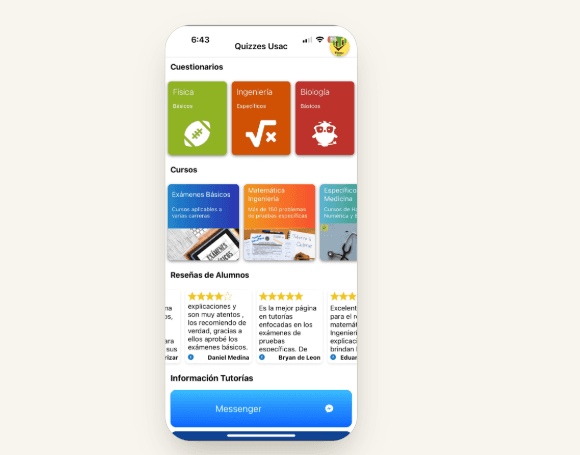
To complement the learning experience on Virtual Tech GT(Web), Virtual Tech GT also built a companion mobile app focused on interactive quizzes and knowledge reinforcement. Built in React Native, it lets students practice the concepts from their courses in short sessions, track how their performance changes over time, and do it from a phone — deliberately outside the checkout-and-classroom flow of the web platform, which isn't built for a five-minute study session between classes.
As Software Developer (Virtual Tech GT, June 2019 – September 2022), I built frontend and backend features for the app using React Native, Kotlin, Java, Spring Boot, and AWS. The product bet behind it is simple: the web platform sells and delivers a course, but repetition is what actually makes the material stick, and repetition only happens if practicing is close to frictionless.
Practicing Like the Real Test
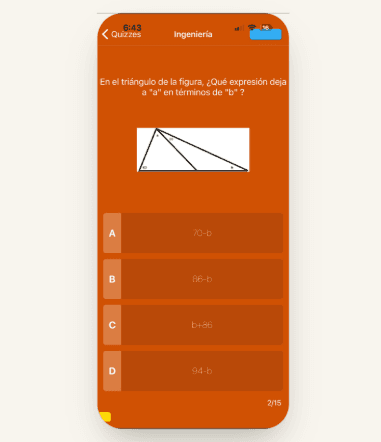
The quiz content itself is written to mirror exam-style questions rather than generic true/false flashcards, since the goal isn't just exposure to the material, it's reducing the gap between how a student studies and how they'll actually be assessed. That distinction matters commercially as much as pedagogically: for an institution whose value proposition is the certificate at the end of a course (see Quizzes Usac (Web)), a practice tool that builds real test-taking confidence protects pass rates — and pass rates are what make an institution's certification worth paying for in the first place.
Key Responsibilities & Achievements
- Built the React Native mobile app for interactive, course-tied quizzes, scoped deliberately narrow — a fast practice loop, not a second course-browsing app — so it stayed genuinely quick to open between classes.
- Implemented progress tracking, giving students a visible signal of improvement over time instead of a quiz being a one-off, disconnected activity.
- Integrated the app with backend REST APIs (Kotlin, Java, Spring Boot) shared with the web platform, keeping quiz content tied to a student's actual course enrollment rather than a generic question bank.
- Developed a responsive, mobile-first UI for quiz-taking flows, optimized for short, anytime/anywhere practice sessions rather than long-form study.
- Contributed to cloud infrastructure and application performance on AWS supporting both the web platform and the mobile app.
Tech Stack
| Layer | Choice |
|---|---|
| Mobile | React Native, TypeScript |
| Backend | Kotlin, Java, Spring Boot — REST APIs (shared with Quizzes Usac Web) |
| Infrastructure | AWS |
Key Learnings
A quiz app only reinforces learning if it's frictionless to open. Keeping the app scoped to "practice a quiz in a couple minutes" rather than replicating the full course-browsing experience of the web platform kept it genuinely usable as a quick between-classes reinforcement tool, not a second app students had to relearn.
Question quality is the actual product, not the app shell around it. Writing practice questions to mirror real exam style — not just covering the same topics — is what turned the app into something that measurably prepares a student, instead of a gamified but shallow flashcard exercise.
Sharing a backend between a transactional web platform and a lightweight mobile app works well when the mobile client only needs a thin slice of the API surface — quiz content and progress, not the full course-commerce contract — which kept the mobile app's integration surface small and easy to reason about.